Sir William Herschel determined the relative energy of sunlight by using a simple optical prism and passing sunlight through it. The typical rainbow colours appeared and at the end of the red visible colour he used a thermometer to measure the temperatures and found that the temperature was rising. He concluded that the spectrum of the sunlight was continuing beyond the visible red light – he called this INFRARED.
 Non-contact infrared temperature measurement
 uses the infrared radiation emitted by objects at a certain temperature. While the whole range of infrared temperature measurement is in the wavelength range of 0.75 μm to 1000 μm, it is separated into different subranges (commonly used):

The main ranges for non-contact temperature measurement are the NIR, SWIR, MWIR and LWIR ranges covering wavelengths of 0.75 - 15 μm. It is therefore called “Thermal Infrared”. Some special devices are designed to work in the visible light range, for example at 550 nm.
Following the Planck’s Radiation Law and the Wien's displacement law, typically with short(er) wavelength instruments, higher temperatures are measured. The lower the application temperature, the longer the wavelength (spectral response) of the instrument (pyrometer/scanner/imager) is – and vice versa.
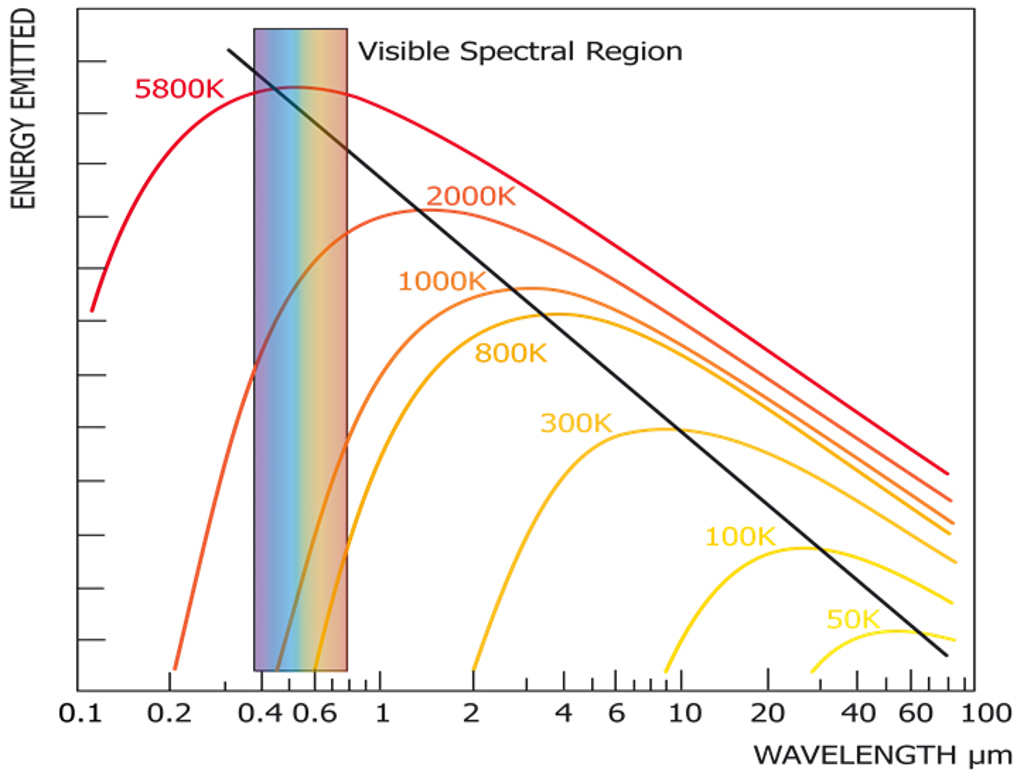
The below diagram shows typical temperature ranges covered by different spectral responses of infrared radiation temperature measurement devices.

To choose the best instrument for a specific application – apart from critical application conditions – the process temperature is one of the main parameters determining the instrument wavelength required.
Commonly it is important to select the shortest possible wavelength of an instrument within the range to minimize the reading error due to changes in the measurement conditions, like the emissivity of the object to be measured.
These are not the only parameters and conditions to be considered when selecting the best instrument. If you would like further expert advice on the
non-contact temperature measurement system required for your specific industrial process/application,
please contact us.
FREQUENTLY ASKED QUESTIONS
1. What is the thermal infrared range?
The thermal infrared range spans approximately 1 µm to 14 µm wavelength and is divided into three practical bands for industrial temperature measurement: SWIR (Short-Wave IR), MWIR (Mid-Wave IR) and LWIR (Long-Wave IR). Understanding these bands is fundamental to selecting the right pyrometer or thermal imager because each band performs optimally for specific temperature ranges and application conditions.
2. SWIR vs MWIR vs LWIR — what's the difference?
SWIR (approximately 0.9–1.7 µm) delivers best performance for very high temperatures above 1,000°C—ideal for molten metal, furnace interiors and glass. MWIR (3–5 µm) handles mid-range industrial temperatures from 300°C to 1,800°C and critically sees through smoke and combustion gases that blind other wavebands. LWIR (8–14 µm) excels at ambient and lower temperatures from -20°C to approximately 500°C LAND offers instruments optimized for each band to match your specific application.
3. What's the best wavelength for molten steel?
For molten steel temperature measurement, SWIR (around 1 µm wavelength) is the optimal choice. At these extremely high temperatures (1,400–1,600°C), targets radiate strongly in the short-wave band, providing a clean, high-energy signal. LAND's SPOT+ MM (Meltmaster) and Cyclops 390L handheld pyrometer are specifically designed for molten metal applications, using this wavelength to deliver accurate readings despite challenging surface conditions.
4. Why use different wavelengths for different materials?
Different materials emit thermal radiation with different efficiency (emissivity) at different wavelengths. Matching the measurement wavelength to the material's emissivity characteristics is essential for accuracy. For example, metals have very low emissivity at longer wavelengths but higher and more stable emissivity in SWIR. Glass is opaque at certain wavelengths, requiring specific band selection. Choosing the wrong wavelength can introduce measurement errors of hundreds of degrees.
5. What is FIR used for?
Far-infrared (FIR, approximately 15 µm to 1 mm wavelength) sits beyond the thermal bands used for industrial process temperature measurement. FIR is primarily used in specialized applications like astronomy, atmospheric research and certain gas detection scenarios. For industrial non-contact temperature measurement across steel, glass, cement, power and other process industries, LAND instruments operate within the SWIR, MWIR and LWIR bands where the technology is mature and proven.