One of the most common questions I receive from customers is, “What effect does water have on my opacity reading?”.
The answer depends on whether the water is present as vapour or as condensed droplets. All AMETEK Land opacity monitors operate at a wavelength of 525 nm in the green part of the visible spectrum. As shown in Figure 1, none of the common atmospheric gases, including water vapour, absorb at this wavelength. Since there is no absorption, the opacity reading is not affected by water vapour, even at high concentrations.
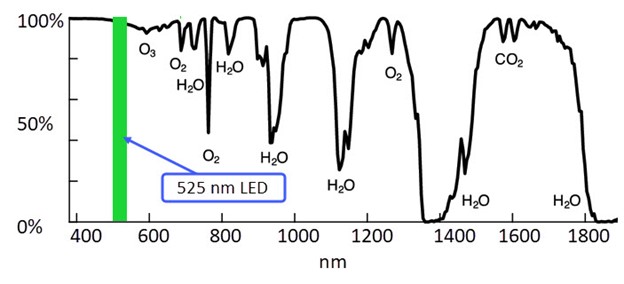
Figure 1 Atmospheric transmittance versus wavelength, with LED spectrum shown in green
An opacity monitor works by measuring the amount of light lost through scattering and absorption by particles in the flue gas, as shown in Figure 2. If there are no particles, there is no loss of light and the opacity reading is 0%. Unfortunately, an opacity monitor cannot distinguish a water drop from a dust particle, so it will indicate a high opacity value if there are droplets of condensed water in the gas stream.
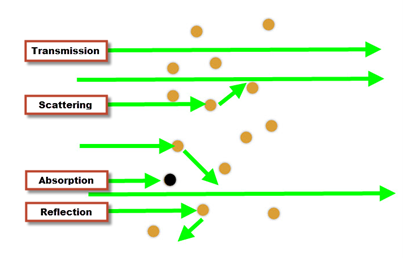
Figure 2 Light Scattering
In most cases, the flue gas temperature remains well above 100 °C (212 °F) at all times, so the water always remains in the vapour phase. The main exception to this is after a wet flue gas desulphurisation (FGD) plant, where a slurry of limestone and water is sprayed into the flue gases to absorb the sulphur dioxide. The gases downstream of the FGD generally have a high concentration of condensed water and will always have an opacity of 100%. For this reason, an opacity monitor should not generally be installed after a wet FGD.
Condensed water is also possible in cases where the flue gas temperature is only a little above the dewpoint. In this case, the cool purge air from the instrument can cause the temperature to drop below the dewpoint when it mixes with the flue gases, leading to local condensation. Unlike the wet FGD, this is a small effect and generally leads to a small increase in the measured opacity. Increasing the flue temperature by a few degrees is generally sufficient to prevent this effect.
Click here to learn about our opacity monitors